Bangor
Criminal Justice – AAS
The Criminal Justice (CRJ) program is designed to provide a solid foundational understanding of the American justice system. Students are required to complete a range of major courses that blend academic learning with a highly emphasized experiential focus. Under the instruction of a diverse faculty of practicing professionals, hands-on learning exercises are utilized to translate conceptual awareness into real-world application of knowledge. Individual and team-based classroom learning is also augmented by internship opportunities in area agencies and offices. The program is designed to meet the needs of both traditional and non-traditional students who seek to gain the education necessary to penetrate or advance within any number of justice professions. Students will need to earn a C or better in each course in order for it to count towards graduation.
Graduates of the Criminal Justice program will be well-positioned to:
- Complete a Bachelor’s degree in Criminal Justice at a four-year college or university
- Apply to the Maine Criminal Justice Academy (MCJA) Law Enforcement Pre-Service Training Program OR Basic Law Enforcement Training Program
- Seek entry-level employment in private security, law enforcement, corrections, and the courts
Professional career opportunities include but are not limited to:
- Municipal Police Officer
- County Sheriff’s Deputy
- State Trooper
- Game Warden
- Marine Patrol Officer
- Fire Marshal
- Corrections Officer Probation Officer
- Dispatcher
- Victim-Witness Advocate
- Loss Prevention Worker
- Fraud Investigator
Key Learning Objectives
- Explain the core responsibilities of the police, courts, and corrections as each relates to the administration of justice within the American criminal justice system.
- Describe the sequential movement of an individual accused of a crime through the various stages of the investigation, adjudication, sentencing, and corrections.
- Compare and contrast the adult and juvenile justice systems in modern American corrections.
- Apply conceptual knowledge to the application of laws of evidence, search and seizure, and arrest.
- Utilize current information and management tools to gather and evaluate data used by justice practitioners.
- Analyze and employ ethically driven critical analysis skills in decision-making.
Prerequisites
- AAS Degree – High school level Algebra I required.
Stay Connected
Contact
- Cornel Plebani, Chair
207.974.4829 | cplebani@emcc.edu
Southern New Hampshire University
Online
Criminal Justice – AS
Earn a Criminal Justice Associate Degree
- $320/credit (60 credits)
- Transfer up to 45 credits toward your associate degree
- Get up to 12 credits for law enforcement training
- Instructors with real-world experience
- Continue on to earn your BS and MS in Criminal Justice
- No application fee or SAT/ACT scores required
Criminal Justice Associate Degree Program Overview
Gain a better understanding of law enforcement with an Associate of Science (AS) in Criminal Justice degree online at Southern New Hampshire University. You’ll have an array of courses to choose from, allowing you to obtain a thorough overview of the American justice system, criminal law, social science and more, expanding your opportunities when you graduate.
Our criminal justice associate degree was created with a real-world perspective. Expanding the boundaries of a traditional criminal justice program, you’ll be exposed to current criminology theories and emerging national and global trends.
Our AS in Criminal Justice program is suited for both experienced criminal justice professionals who want to upgrade their skill set and those seeking entry-level professional positions in the field.
Learn how to:
- Explore career possibilities and responsibilities in criminal justice
- Collect and convey information to diverse audiences within the profession and community
- Examine laws, regulations and best practices to inform decision-making
Get credit for law enforcement training: If you have completed basic police, corrections or probation and parole academy training, you may receive up to 12 credits toward your criminal justice degree at SNHU.
Career Outlook
One reason you may want to earn your criminal justice associate degree is that many law enforcement positions don’t require a bachelor’s degree.
Since on-the-job experience is critical to advancing in most criminal justice fields, earning an associate degree to get your career started makes sense – just as you may want to return for a bachelor’s or even a master’s degree as you advance and job requirements change.
The associate degree in criminal justice was designed to help you prepare for entry-level jobs in many fields including:
- Business security
- Corrections
- Court administration
- Dispute resolution
- Law enforcement
- Victim advocacy
According to the U.S. Bureau of Labor Statistics, a number of positions are expected to see growth through 2031, particularly social and human service assistants (12%).1
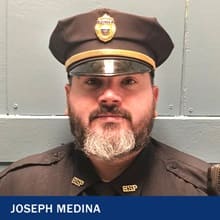
Not only did his education help Medina professionally, but it also made a big impact on his personal life.
“The promotion has enabled me to better provide for me and my son,” he said. “My degree has made my son realize the importance of education and has motivated him to want to go to college.”
A bump in pay is oftentimes another reason students feel an associate degree is worth earning. According to the U.S. Bureau of Labor Statistics (BLS), 2021 median weekly earnings for all full-time workers were 16% higher for those who’ve earned an associate degree over those with a high school diploma.1
Not only could your pay increase, but the unemployment rate drops significantly for associate degree holders in comparison to high school graduates.1
Note: Law enforcement positions may involve additional training and eligibility requirements.
Admission Requirements
Expanding access to quality higher education means removing the barriers that may stand between you and your degree. That’s why you can apply at any time and get a decision within days of submitting all required materials:
- Completed free undergraduate application
- Prior transcripts, which we can retrieve at no cost to you
- Test scores are not required as part of your application
Acceptance decisions are made on a rolling basis throughout the year for our 6 (8-week) undergraduate terms.
How to Apply
If you’re ready to apply, follow these simple steps to get the process going:
- Complete a free undergraduate application
- Submit any additional documents required
- Work with an admission counselor to explore financial options and walk through the application process
If you have questions or need help filling out your application, call 1.888.387.0861 or email enroll@snhu.edu.
In our criminal justice associate degree program, you’ll find your classes are mostly an even split of general education courses and classes for your major – and you’ll discover how well they can all work together.
For instance, both sets of courses can help you develop such in-demand skills as:
- Communication
- Cultural awareness
- Research literacy
- Statistical analysis
The criminal justice curriculum introduces you to a spectrum of ideas, theories and practices related to the criminal justice system in the United States. Designed to give you a strong foundation, the coursework can provide you with core principles to help you start or advance your career. Some of these key courses you’ll be able to explore are:
- Cultural Awareness in Criminal Justice
- Communication Skills for Criminal Justice
- Discretion in Criminal Justice
You’ll learn from instructors who have been gaining hands-on experience in the field – firsthand knowledge they want to pass on to you. Our criminal justice faculty have worked for major law enforcement agencies, including:
- Atlanta Police Department
- Chicago Police Department
- Federal Bureau of Investigation (FBI)
- Federal Emergency Management Agency (FEMA)
- Homeland Security
- Houston Police Department
- Miami Police Department
- New York Police Department (NYPD)
And so have our students. Joseph Medina earned a promotion with the Boston School Police Department after completing his associate degree coursework in 2017.
“I feel that through my education I learned more about the other agencies that I interact with, such as the court system and the corrections system,” Medina said. “I also learned a great deal about how a lot of the principles and tactics utilized in modern policing came to be.”
With over 7,500 students at Southern New Hampshire University also studying criminal justice, you’ll be in good company – especially if you decide to continue your education after earning your associate degree.
Your coursework throughout your criminal justice associate degree can seamlessly transfer into the Bachelor of Science in Criminal Justice online degree program. Aside from building off the hands-on curriculum you’ve become familiar with, you also have the option to add one of 7 concentrations to your program:
- Corrections
- Criminology and Crime Analysis
- Homeland Security & Counterterrorism
- Human Services & Advocacy
- Police Administration & Operations
- Security Management
- Substance Abuse
Concentrations allow you to develop additional expertise in a specific area – which may give you the opportunity to get ahead in the workplace.
Beyond a bachelor’s, you have the opportunity to earn a master’s in criminal justice with concentration options of public safety administration and advanced counterterrorism.
Another benefit of earning your criminal justice associate degree online at SNHU is that your program includes 12 free elective credits. These are ideal for transfer students who may have changed majors and want to keep the credits they’ve earned, as well as for students who are interested in further criminal justice study beyond the program requirements.
University of Maine at Augusta
Online
Justice Studies – AS and Certificates
Justice Studies offers students interested in law enforcement at the federal, state or local level, security (tangible or virtual), corrections and/or probation, investigations of tangible or cyber crime, or the law—as lawyer or paralegal—the opportunity to acquire an academic foundation for all law-related fields and a credential in one or two specialties.
UMA’s Justice Studies program offers a bachelor’s degree and an associate degree as well as Certificates in Paralegal Studies, Community Policing, Forensics, and more. UMA and University of Maine Law School offer a joint accelerated 3+3 program for UMA students interested in pursuing a legal career.
In collaboration with the Business Administration Program, JUS offers a minor and certificate in Fraud Examination, which enables the student to sit for the national fraud exam; and in collaboration with the Computer Information Systems Program, an Information Security Certificate, which prepares the student to work in cyber-security.
The program also offers an Advocacy Minor for students to research, present, and defend their cause in any law-related forum—court, legislature, and administrative agencies.
Flexibility with Online Courses
Many Justice Studies students are returning students whose academic education was interrupted by parenthood, military service, or the economy and who bring their family and work commitments with them. To accommodate those needs, the Justice Studies program offers the majority of its courses online. Some live and video conference classes are available in Augusta, Bangor and UMA Centers and sites.
The program also gives academic credit for selected military and police training and accepts CLEP and Dantes exams results for academic credit. The program allows students with course-related employment experience to challenge those particular courses by exam or portfolio.
The Maine Community Policing Institute (MCPI) provides education, training, and technical assistance to members of the public and the police who protect them with the goal of creating proactive problem solving to enhance community wellbeing and quality of life through public safety partnerships.

Being a student at UMA was very different than what I expected. Being in a mostly-online program, I expected a sense of disconnect and not a sense of community. I found instead that I have been able to be involved in a lot of activities, and people here are very involved in the community.
– Scott C., Rising Scholar ’18
Certificates
The field of Justice Studies is diverse and encompasses investigation theory, legal analysis, interpretation of laws and statutes, comparison of international and regional justice systems, the study of contemporary social issues, and problem-solving. UMA’s Justice Studies program has many related Certificates that span a variety of subjects and can be earned concurrently with your degree or on their own.
Advanced Criminal Justice Management
Community Corrections
Community Policing
Crime Analysis & GIS
Cyber Forensics
Digital Forensics
Forensic Science – Scientific Focus
Forensic Science – Investigative Focus
Fraud Examination
Mediation
Paralegal
University of Maine at Fort Kent
Online
Criminal Justice, General Studies – AS
Earn an Associate of Arts degree online or on-campus with a concentration in criminal for employment or advancement in the criminal justice system and with various law enforcement agencies at the federal, state, regional, and local levels. This degree may be used as a gateway to the Bachelor of Science in Rural Public Safety Administration.
The Criminal Justice studies program at UMFK offers a two-year degree (Associate of Arts) in Criminal Justice. The degree program is designed to academically-prepare students with the professional skills to seek employment or advancement in the criminal justice system and with various law enforcement agencies at the federal, state, regional, and local levels. Many students have been employed as police officers, deputy sheriffs, state troopers, game wardens, as well as federal officers in Customs, Border Patrol, FBI, and other agencies.
Calais
Criminal Justice – AAS
Purpose: The Associate in Applied Science (AAS) degree in Criminal Justice is designed with a three-fold purpose: (1) to prepare graduates for entry level positions relevant to law enforcement, (2) to prepare students for upper division coursework at universities and colleges where a bachelor’s degree is desired, and (3) to respond to the growing demand of law enforcement employees seeking to upgrade their skills and knowledge base for career advancement with a college degree.
Career Opportunities: Graduates of the program will be qualified for positions such as detectives and criminal investigators, correctional officers and jailers, forensic science technicians and protective service workers including TSA agents, security systems personnel, homeland security officers, reserve officer, safety officers, intake worker positions, jail transport officers.
Program Education Outcomes: Upon completion of the Associate in Applies Science Degree in the Criminal Justice Program, the graduate is prepared to:
- Demonstrate an understanding of the sociological and psychological theories of crime causation and evaluation of human behavior.
- Apply critical thinking and problem solving techniques to the criminal justice and computer forensics environment.
- Demonstrate the ability to apply principles of statutory law and due process within the criminal justice system.
- Demonstrate interpersonal, written, and presentation skills required for successful employment in a criminal justice field.
- Consistently exhibit ethical behavior and respect for a diverse community, applying services equitably to all people.
- Be a responsible member of society and the workforce, applying knowledge skills and abilities, ultimately, for the betterment of one’s local community.
The Criminal Justice program requires completion of the Student Disclosure of Criminal Convictions, Pending Criminal Charges and Certain Disqualifications. Completion of this form does not automatically deny admission to the program. Prospective applicants will meet with the Dean of Enrollment Management and Student Services to review information.
 Hub 1 College & Career Program Options